


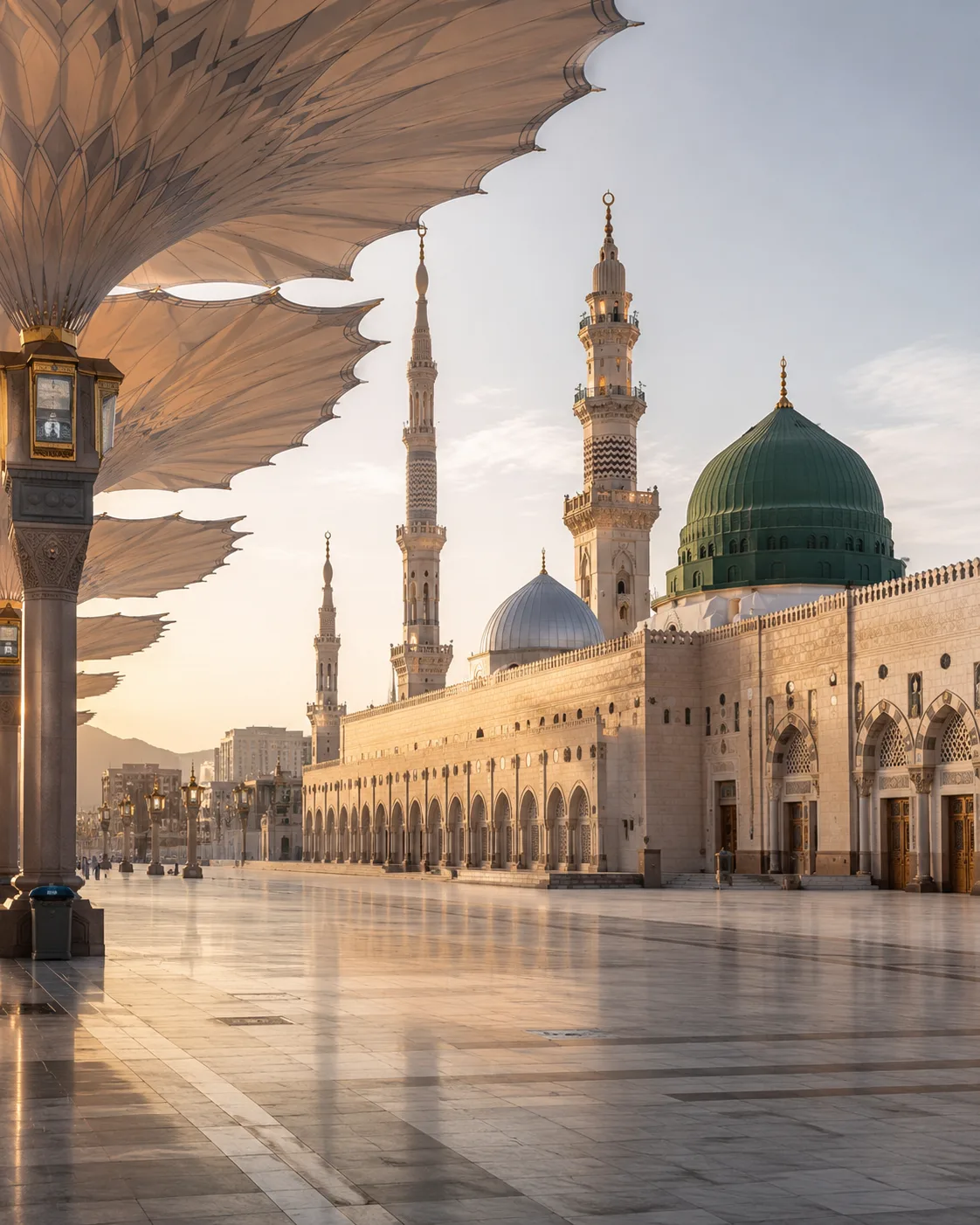
Medina holds a distinct place in Islamic history — for many pilgrims, it is remembered as fondly as Makkah itself, if not more so. Known as "the illuminated city," Medina isn't just the resting place of the Prophet ﷺ; its streets, mosques, and mountains carry the layered history of the earliest Muslim community. If you're visiting for the first time, here are the places most worth understanding before you go.
Masjid an-Nabawi
No list of Medina's significant sites can start anywhere else. The Prophet's Mosque is the heart of the city, and most pilgrims choose to visit it independently and repeatedly during their stay, rather than as a single guided stop — its rhythm of prayer times deserves unhurried time of its own. Its green dome, marking the Prophet's ﷺ resting place beneath it, is one of the most recognisable sights in the Islamic world.
Jannat al-Baqi
Just beside Masjid an-Nabawi lies Jannat al-Baqi, the principal cemetery of Medina, where many of the Prophet's ﷺ family members and companions are buried. It's a place of quiet reflection rather than a "sight" in the tourist sense — many pilgrims visit briefly, offer supplication, and reflect on the lives of those who shaped early Islamic history.
Masjid Quba
A short drive from the centre of Medina, Masjid Quba holds a particular distinction: it is widely regarded as the first mosque built in Islamic history, established by the Prophet ﷺ upon his arrival in Medina after the migration from Makkah. Its calm, unhurried atmosphere — a world away from the intensity of the Haramain — makes it a favourite stop for many visitors, and praying two rak'ahs there is considered especially rewarding.
Masjid Al-Jumu'ah
Close to Masjid Quba, this modest mosque marks the site of the very first Friday prayer led by the Prophet ﷺ after his arrival in Medina. It's a smaller, quieter stop than most on this list, but one that carries genuine historical weight for those who know its story.
Masjid Al-Qiblatain
"The Mosque of the Two Qiblas" marks the spot where the direction of prayer changed from Jerusalem to Makkah, during the Prophet's ﷺ own lifetime. Its distinctive twin-dome architecture reflects this history directly — a rare physical marker of a moment that reshaped Islamic practice.
Mount Uhud and the Martyrs' Cemetery
Mount Uhud sits at the edge of the city and marks the site of one of the most significant battles in early Islamic history. At its base lies the resting place of the martyrs of the Battle of Uhud, including Hamza ibn Abdul-Muttalib, the Prophet's ﷺ uncle. Many guides also point out the nearby hill known as the Mount of the Archers, whose story is closely tied to the events of the battle. Standing at the site brings a different kind of reflection than the mosques of the city — one rooted in sacrifice rather than worship.
The Seven Mosques and the Trench (Khandaq)
Clustered together on the western edge of Medina, the Seven Mosques mark the historical site of the Battle of the Trench, one of the defining moments in the early defence of the Muslim community. Though modest in scale compared to the Haramain, the area carries considerable historical weight for those familiar with the events it commemorates.
A quieter stop: Aryaf Taibah
Not every meaningful part of a Medina visit is a historical site. Many private tours build in a pause at a traditional date farm on the way between stops — a chance to rest, drink coffee, and taste dates in a setting that reflects the region's agricultural heritage, before continuing on to the next site.
Practical notes for visiting
Most of these sites, aside from Masjid an-Nabawi itself, are spread across the city and best visited together on a single guided route rather than independently — the distances between them, combined with the historical context each one needs, make a private, planned visit considerably more worthwhile than trying to piece it together alone. Comfortable shoes, modest dress, and a little patience for the desert heat outside the mosques are the only real preparation required.
Visiting with context, not just a checklist
Medina rewards a visit that goes beyond ticking off locations. Much of what makes these places meaningful is the history behind them — who was there, what happened, and why it still matters today. A private guide who can walk you through that context, rather than simply pointing at buildings, tends to make the difference between visiting a site and actually understanding it.